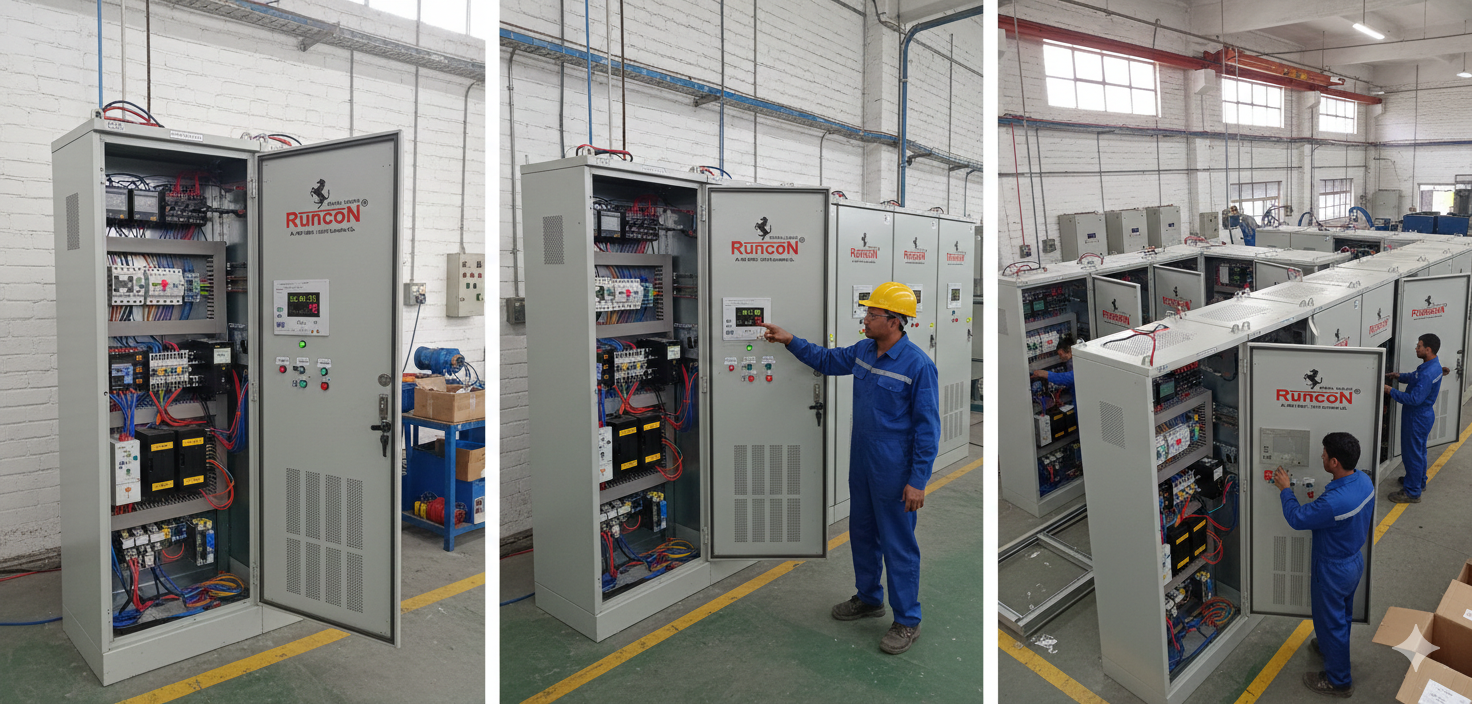

Intelligent automatic power factor correction panels that cut electricity penalties, reduce losses and protect your electrical system in real time.
RuncoN, a brand of Maurya Enterprises, is an ISO 9001:2015 certified APFC panel manufacturer and supplier based in Delhi, India. Our automatic power factor correction panels monitor your load continuously and switch capacitor steps in and out, so your power factor stays close to unity without any manual work.
Whether you run a factory, a hospital, a commercial complex or a data centre, a correctly sized APFC panel lowers your electricity bill, frees up transformer capacity and extends the life of your motors and cables. We build every panel to your load profile, with options for standard, heavy-duty and detuned (harmonic filter) configurations from 10 kVAr up to 1000 kVAr and above.
Get a Quote · Call +91 93108 21045
An APFC panel (Automatic Power Factor Correction panel) is an electrical control panel that keeps the power factor of your installation near 1.0 by automatically switching capacitor banks according to the reactive load at any moment.
Motors, transformers, compressors, welding machines and fluorescent lighting are inductive loads. They need reactive power (kVAr) to build their magnetic fields, and this reactive power adds to the current drawn from the supply without doing useful work. The result is a low power factor.
An APFC panel fixes this at the source by supplying the reactive power locally, so the utility does not have to.
An APFC panel works as a closed loop: it measures the power factor, compares it with a target, and adds or removes capacitor steps until the two match.
Because steps are of different sizes (for example 5, 10, 20 and 25 kVAr), the panel can match the load closely without hunting or over-correcting.
Every RuncoN APFC panel is built from the components below, selected for the duty of each step and the harmonic level of your plant.
| Component | What it does |
|---|---|
| APFC relay (power factor controller) | Measures power factor and switches steps automatically. Available in 6, 8, 12 and 14 stage versions, with display, alarms and manual mode. |
| Capacitors | Supply the reactive power. Standard duty, heavy duty (440 V or 525 V rated) and detuned-duty types are used depending on your harmonics. |
| Capacitor-duty contactors | Switch the capacitors with damping resistors to limit inrush current when a step is energised. |
| Detuned reactors | Connected in series with capacitors in harmonic-rich plants to prevent resonance and protect the capacitors. |
| Incomer (MCCB, ACB or switch-fuse) | Main isolation and protection for the whole panel. |
| HRC fuses, MCCBs or MCBs | Short-circuit and overload protection for each capacitor step. |
| Busbars | Aluminium or copper busbars sized for the full panel current, supported on insulators. |
| Current transformer (CT) | Gives the relay a current signal proportional to the load current. |
| Discharge resistors | Discharge each capacitor after switch-off for safety. |
| Cooling fans and filters | Keep the internal temperature within limits for long capacitor life. |
| Meters and indication | Ammeter, voltmeter, multifunction meter and ON/OFF lamps for each step. |
| Enclosure | Sheet-steel, powder-coated cubicle with cable entry, compartmentalised layout and clear phase segregation. |
Proper ventilation, tidy cable management and phase segregation inside the cubicle are not extras. Capacitors run hot, and a well-laid-out panel is what keeps them in service for years.
| Parameter | Specification |
|---|---|
| Panel type | Automatic Power Factor Correction (APFC) panel, indoor |
| System voltage | 415 V AC, 3 phase, 4 wire, 50 Hz (440 V on request) |
| Panel rating | 10 kVAr to 1000 kVAr and above, customised |
| Number of steps | 4, 6, 8, 12 or 14 steps with mixed step sizes |
| Capacitor type | Standard duty, heavy duty (440 V or 525 V), detuned duty |
| Detuned reactor option | 5.67%, 7% or 14% tuning |
| Switching | Capacitor-duty contactors; thyristor switching on request |
| Controller | Microprocessor-based APFC relay, 6 to 14 stage |
| Target power factor | Adjustable, 0.90 lag to unity |
| Incomer | MCCB, ACB or switch-fuse unit as per rating |
| Busbar | Aluminium or copper, sized for panel current |
| Enclosure | CRCA sheet steel, powder coated, wall or floor mounted |
| Protection class | IP42 standard, IP54 on request |
| Cooling | Forced ventilation with fans and filters |
| Metering | Ammeter, voltmeter, multifunction meter (optional) |
| Quality system | ISO 9001:2015 certified manufacturer |
The right type depends on how much of your load is non-linear and how fast your load changes. We build all four types below.
| Type | Best for | Key feature |
|---|---|---|
| Standard APFC panel | Plants with mostly motor loads and few harmonics | Standard or heavy-duty capacitors, contactor switching |
| Detuned APFC panel | Plants with VFDs, UPS, LED drivers, welding or other non-linear loads | Capacitor in series with a reactor to avoid resonance |
| Thyristor-switched APFC panel | Fast-changing loads such as presses, cranes and welding | Solid-state switching with no contactor wear, response in milliseconds |
| Fixed or wall-mounted capacitor bank | Small loads and single-machine correction | Compact, low cost, simple connection |
We also build APFC panels for floor mounting with front access, and panels combined with an LT panel or MCC panel when you want everything in one lineup.
Contactor-switched panels are the standard and most economical choice for loads that change over seconds or minutes. Thyristor-switched panels use solid-state switches, which respond faster and have no moving parts to wear out, so they suit loads that change many times a minute. Tell us your load pattern and we will recommend the right one.
If your plant has variable frequency drives, UPS systems, LED lighting, welding sets or other electronic loads, use a detuned APFC panel. A plain capacitor bank in such a plant can resonate with the transformer at a harmonic frequency, which overheats and destroys capacitors and can trip breakers.
A detuned reactor is connected in series with each capacitor step. It moves the resonance point of the circuit below the lowest harmonic present, so the capacitor can no longer amplify it.
| Reactor tuning | Tuned near | Typically used when |
|---|---|---|
| 5.67% (about 210 Hz) | 4.2th harmonic | Strong 3rd harmonic is not expected; 5th harmonic is dominant |
| 7% (about 189 Hz) | 3.8th harmonic | The most common choice for 5th and 7th harmonic loads |
| 14% (about 134 Hz) | 2.7th harmonic | A significant 3rd harmonic is present |
In detuned panels the capacitors are rated for a higher voltage (typically 440 V or 525 V) because the reactor raises the voltage across them. As a commonly cited rule of thumb, once non-linear loads make up around 15% or more of your transformer rating, a detuned panel is the safer choice. If you are not sure, we can review your load list or harmonic measurement and recommend the right tuning.
Any site with a large inductive load and a monthly electricity bill with a power factor clause can benefit from an APFC panel. Our panels are installed in:
We supply APFC panels across Delhi NCR (Delhi, Noida, Ghaziabad, Gurugram, Faridabad) and deliver across India.
An APFC panel pays for itself by removing a cost you are already paying. The main benefits are:
| Before | After | |
|---|---|---|
| Power factor | 0.78 | 0.95 |
| Apparent power (kVA) | about 256 | about 211 |
| Current drawn | 100% | about 82% |
The same 200 kW of useful work needs about 18% less current from the supply once the power factor is corrected.
The kVAr you need is the difference between the reactive power you draw now and the reactive power at your target power factor. Use this formula with your maximum load in kW and the power factor from your electricity bill. You can also use our kVAr calculator.
kVAr required = kW × (tan φ1 − tan φ2)
Here φ1 is the angle at your present power factor and φ2 the angle at your target power factor.
Worked example: a plant draws 200 kW at 0.78 power factor and wants 0.95. Then tan φ1 = 0.802 and tan φ2 = 0.329. The kVAr required is 200 × (0.802 − 0.329) = about 95 kVAr, so a 100 kVAr panel is the right size.
Mixed step sizes let the panel match the load closely instead of hunting between two coarse steps.
| Panel rating | Typical steps (kVAr) |
|---|---|
| 50 kVAr | 2, 3, 5, 5, 10, 10, 15 |
| 75 kVAr | 2, 3, 5, 10, 10, 15, 15, 15 |
| 100 kVAr | 2, 3, 5, 10, 10, 20, 25, 25 |
Do not over-size the panel. Too much capacitance gives a leading power factor and can push voltage up, which is penalised by some utilities and stresses equipment.
RuncoN APFC panels are designed and built in line with the standards that govern low-voltage power factor correction equipment. Our manufacturing is ISO 9001:2015 certified.
| Standard | Covers |
|---|---|
| IEC 61921 / IS 16636 | Low-voltage power factor correction banks and APFC equipment |
| IEC 61439 | Low-voltage switchgear and controlgear assemblies |
| IEC 60831 | Shunt power capacitors, self-healing type |
| IEC 60529 | Degree of protection of the enclosure (IP code) |
| ISO 9001:2015 | Quality management system of the manufacturer |
We use components from well-known brands and can match the makes your plant or consultant specifies.
RuncoN builds APFC panels in our own factory in Jhilmil Industrial Area, Delhi, and is trusted by more than 5,400 industries across India.
Looking for an APFC panel manufacturer in Delhi, or a reliable APFC panel supplier anywhere in India? Send us your load details and we will reply with a quotation.
An APFC panel is a working piece of equipment with parts that age, so installation and a regular check are what keep the power factor, and your savings, steady.
A panel that has quietly lost half its steps is a common reason penalties come back. We offer annual maintenance contracts (AMC) that include a step-by-step check and a short report.
APFC stands for Automatic Power Factor Correction. An APFC panel automatically keeps your power factor close to unity by switching capacitor banks.
Unity (1.0) is ideal, but most plants set the target between 0.95 and 0.99. Going slightly under unity leaves a margin so the system never swings into a leading power factor.
It removes the penalty for low power factor, and where billing is in kVAh it also cuts the kVAh you are charged for. It also reduces current and losses in your own cables and transformer.
Use kVAr = kW × (tan φ1 − tan φ2), with your maximum load, present power factor and target power factor. See the sizing section above, or send us your details and we will calculate it for you.
A capacitor bank is the set of capacitors. An APFC panel is the complete system: capacitors plus the controller, contactors, protection, busbars and enclosure that switch them automatically.
When your plant has VFDs, UPS, LED drivers, welding sets or other non-linear loads. The detuned reactor prevents resonance and protects the capacitors from harmonic damage.
Contactor panels are economical and suit loads that change slowly. Thyristor panels switch in milliseconds with no contact wear, and suit fast-changing loads such as presses and cranes.
More steps give finer control. Small panels often have 4 to 6 steps and large panels 12 to 14, with mixed step sizes so the panel can match the load closely.
Yes, but it needs care. A capacitor bank can over-correct on a lightly loaded generator, so the panel should be set up for the DG source or isolated from it. Tell us about your setup and we will design it properly.
Common causes are a wrongly placed or reversed CT, failed capacitors or contactors, blown fuses, and wrong relay settings. A maintenance check usually finds the fault quickly.
With good ventilation, correct detuning and regular checks, panels run for many years. Capacitors and contactors are the parts that wear and may need replacing earlier.
The price depends on the kVAr rating, number of steps, capacitor duty, whether detuned reactors are needed, the incomer and the component makes. Send us your load details for an exact quotation.
Tell us your load, your present power factor and your transformer rating, and we will recommend the right APFC panel and send you a quotation.
RuncoN, a brand of Maurya Enterprises
B 3/49, DSIDC Flatted Factory, Jhilmil Industrial Area, Delhi – 110095
Phone: +91 93108 21045, +91 96540 61234
Email: sunil.morrya@gmail.com
Available 24 hours, 7 days a week
Get a Quote Now · Call Us · WhatsApp